Start at the edge of the picture
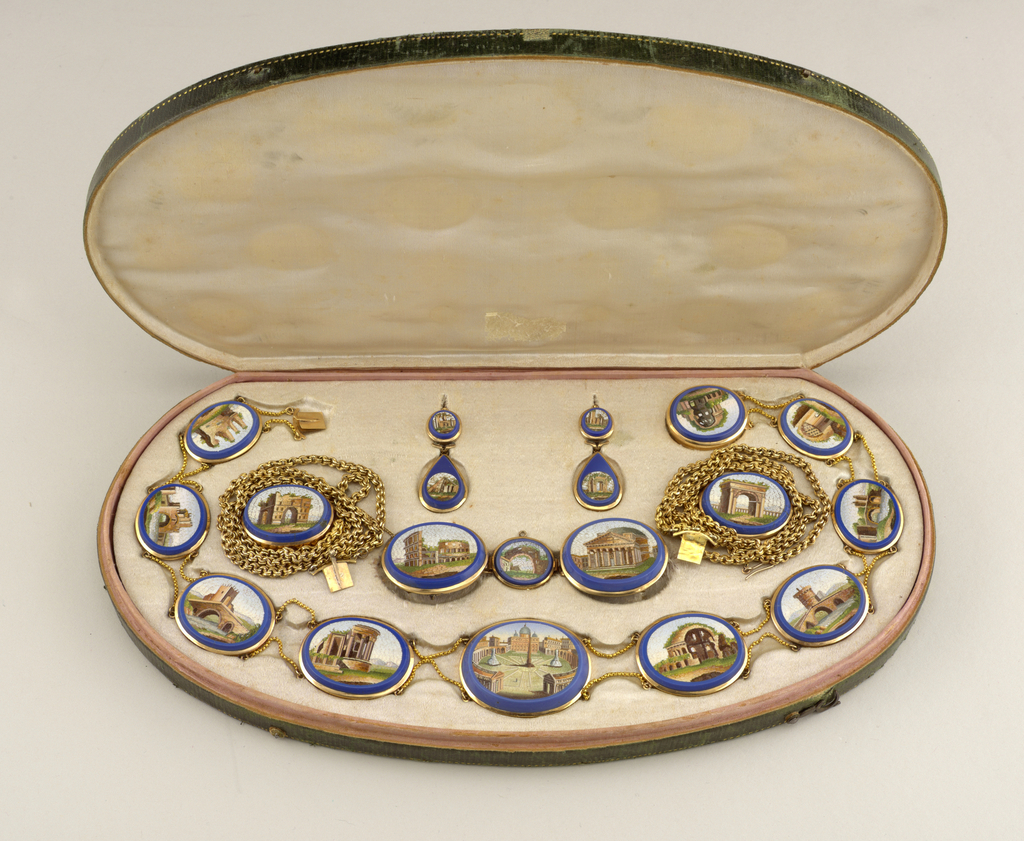
At first the scene seems painted: a pale sky, masonry, a little distance compressed into an oval. Look again at its edge. In a micromosaic, an image is assembled from small pieces called tesserae. Cooper Hewitt describes the coloured glass pieces in this Italian suite and the patient work of arranging them. The photograph shows the suite in its case, rather than an isolated jewel enlarged beyond any sense of scale.
That distinction changes the question you ask. Instead of asking only whether the subject is attractive, ask how colour turns a corner, how a building meets the sky and how the picture fits its mount. These are observations you can make without declaring the object authentic. A photograph can invite investigation; it cannot complete it.
What the museum record establishes
The Smithsonian record dates the suite to 1800–25, identifies Italy as its place of manufacture and lists gold and glass mosaics as its materials. The credit line names Frederick Saal’s gift in honour of Dr. and Mrs. Joseph Saal. Those details belong to this accessioned group. They should not be transferred to a similar-looking brooch offered elsewhere.
The visible blue borders and repeated oval architectural scenes make the set coherent. That is our visual reading. The date, material and acquisition credit come from the institution. Keep those two kinds of statement separate in your own notes: ‘blue border visible’ is different from ‘made in Rome in a particular year.’ A recognisable monument is a subject, not a maker’s mark.
Why a traveller would wear a city
Cooper Hewitt places this jewellery within the souvenir culture of the Grand Tour. Views of Italian architecture let travellers carry a condensed memory of places and artistic education. The appeal was both intimate and social: a small image could prompt a conversation about a much larger journey.
The useful insight is not that every mosaic jewel belonged to a celebrated traveller. It is that a jewel can work as a portable image. When you compare pieces, record the represented place separately from the place of manufacture and the owner’s documented itinerary. One does not prove the others. An attractive travel story deserves evidence just as much as a maker attribution.
Look for construction, without making a verdict
In a clear close view, look for the relationships between individual pieces, changes in direction and the meeting of picture and frame. Do not judge solely by how invisible the joins appear: lighting, image resolution, wear and repairs can conceal or exaggerate them. Printed, painted and assembled images require different descriptions, but a screen may not let you distinguish them confidently.
Ask the seller for an overall front, reverse, side profile, clasp or pin, and sharp close views with a scale. Request a written description of materials, known repairs and the basis for the attribution. A loupe may help you see joins and surface detail in person; it does not turn visual inspection into authentication. If a consequential purchase depends on the distinction, seek a qualified examination of the object.
A comparison card that resists the romance
Use five headings: depicted subject; stated materials; construction visible; condition questions; documentary evidence. Under each, separate what you observed, what a seller asserts and what a named document actually supports. For example: ‘architectural oval visible; glass stated by seller; reverse not photographed; repair history unanswered; invoice supplied but not yet matched to object.’ This is an original working example, not a verdict on a real listing.
Then decide which missing answer could change the purchase. A reverse photograph may matter more than another glamorous front view. An unexplained replacement clasp may need professional assessment; it does not automatically invalidate the entire jewel. Ask for evidence before making either a generous assumption or an accusation.
Let the object finish the story
The suite’s pleasure lies in the tension between a tiny surface and an expansive subject. It rewards slow looking: blue frames keep the scenes distinct while the gold connects them into something wearable. This is editorial interpretation of the image, not a grading scale or valuation method.
Keep any historic composite jewel out of improvised cleaning experiments. Do not assume glass means that immersion, heat or solvents are safe for the setting and other materials. If treatment is needed, obtain advice for the actual piece. A good encounter ends with both delight and an honest list of what remains unknown.
Continue in the archive
Sources and image rights
Museum records, historical sources and image rights checked 29 October 2026.