Begin with the record, not the legend
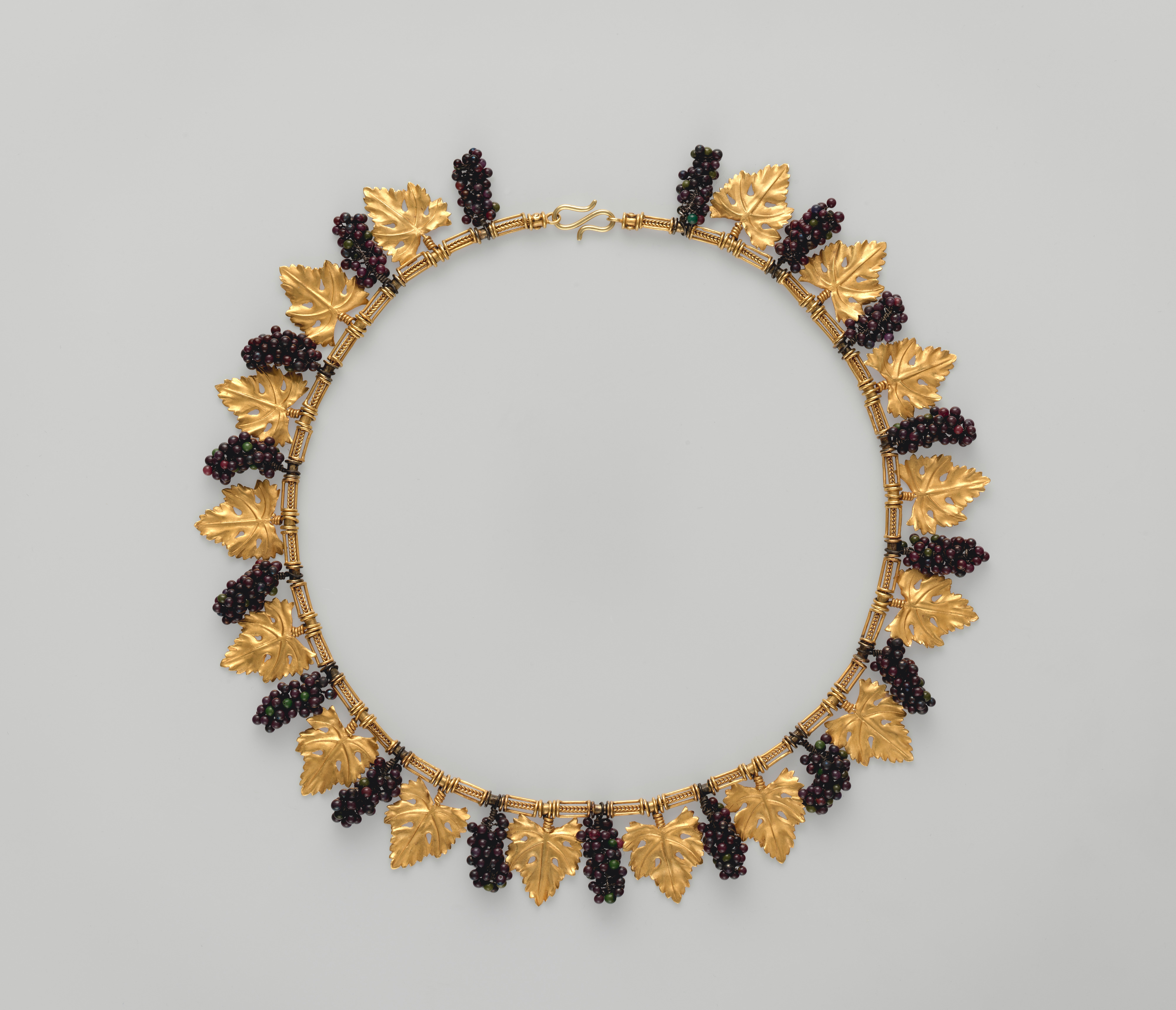
The Metropolitan Museum of Art catalogues this object as an ‘Archaeological revival necklace’, made by Castellani in Rome and dated to about 1880. Its stated materials are gold and glass; its overall length, excluding the S-clasp, is 39.4 cm, and its accession number is 2016.711.2. The record also says it is not currently on view and entered the collection as a gift in 2016.
Those facts are the article’s floor. We do not call the beads gemstones, assign every detail to one individual hand, or infer gold weight, clasp condition or repair history from the photograph. A family-firm attribution is useful history, but another object still requires marks, documents and independent examination.
What does ‘archaeological revival’ mean here?
The Met explains that Castellani looked to Etruscan, ancient Roman, Byzantine and Medieval styles, seeking ancient techniques and motifs for reinterpretation. It places the work within a broad European appetite for historical styles in the second half of the nineteenth century, when archaeological jewellery became fashionable at elite levels.
‘Reinterpretation’ is the important word. An object dated about 1880 is neither an antiquity nor a neutral copy outside time; it was modern design for its first audience, selecting and adjusting the past through proportion, materials and rhythm. That is a design-history reading, not a claim that every motif has one identifiable archaeological prototype.
What can we actually see?
The official photograph shows dark clusters resembling grapes alternating with gold leaves along a fine chain. The repetition can be read as a botanical rhythm: the dark clusters create visual weight, the leaves separate them, and the horizontal sequence keeps each unit legible as the necklace curves around the neck.
That is labelled editorial observation. The catalogue establishes gold and glass, but the photograph does not reveal the glass recipe, the making of every joint or a condition report. Even identifying the forms as ‘grapes’ is a reasonable act of looking, not a surviving workshop caption.
Castellani made history a working material
The Met records that the family shop opened in Rome in 1814 near the Trevi Fountain and continued across three generations. A separate Met bracelet record describes a vocabulary that included granulation, engraved gems, enamelling and micromosaics; it also notes Alessandro Castellani’s expansion to London and Paris in the 1860s and a workshop in Naples.
This does not mean all four techniques appear in the necklace before us; it is documented context for the firm’s wider practice. Castellani’s ‘ancient style’ was not one surface ornament but a project joining study, materials, commercial networks and contemporary goldsmithing. Identifying a specific technique on a market object still requires magnification, expertise and direct examination.
Look at ancient material without inventing a lineage
The British Museum holds Etruscan gold earrings dated 400–350 BCE and officially records granulation among their techniques. It acquired them from Alessandro Castellani in 1872. The entry is useful because it places actual ancient objects, goldsmithing knowledge and the family’s role in the antiquities trade within one entangled history.
It does not prove that those earrings directly modelled this necklace, or that the necklace’s beads or gold are ancient. The disciplined connection is narrower: the firm operated within a world of archaeological knowledge and trade, and the Met itself describes its modern necklace as a reinterpretation of several traditions. Anything more needs design archives, correspondence or a specific technical comparison.
Why ‘copy’ can mislead
A British Museum record for another Castellani-attributed brooch discusses ancient solar-mask prototypes but notes that the later jewel was reduced, stylised for wear and given granulated hair absent from the cited originals. That object does not document our necklace, but it demonstrates how revival work could change scale, construction, ornament and wearability.
A revival should therefore not be judged only by exact resemblance. Its most revealing choices may be the differences: what was omitted, enlarged or made flexible, and which modern material performed a colour or weight that antiquity solved another way. Those are design-critical questions, not authentication evidence.
A collector’s framework: keep four layers separate
When an object is offered as Castellani or ‘Etruscan revival’, separate maker identity, date, material description and ownership history. Request clear front, back, clasp and mark photographs, plus dimensions, weight and repair history. Compare marks with authoritative references, but do not treat stylistic resemblance—or a pair of interlaced Cs—as a final verdict.
The seller should also state whether any ancient elements have been incorporated into a later jewel. ‘Archaeological’ may describe style alone or be used to imply material age; that difference is fundamental. A specialist may address manufacture and condition, a laboratory may identify materials within its scope, and provenance evidence may support history. This article provides no authentication, financial valuation or investment recommendation.
Why there are no shopping links
This article is about reading a historical object and a museum record, not choosing a home tool or care product. We therefore added no Amazon.sa recommendations: a loupe or cloth cannot replace specialist examination, and forcing a commission link into an unrelated subject would weaken editorial independence.
The accompanying image depicts the necklace itself—not a retailer product or generic substitute. The Met marks it Public Domain and provides it through Open Access. Its credit and source link are visible here, while our visual observations remain distinct from documented catalogue data.
Sources and limits
Object, firm-history and image-rights facts come from institutional records. Rhythm and design-choice analysis is explicitly editorial—not a condition report, authentication or valuation. Object records and image rights checked 17 August 2026.
- The Metropolitan Museum of Art — Archaeological revival necklace, Castellani, ca. 1880, 2016.711.2 ↗
- The Met Open Access API — public-domain object record and image ↗
- The Metropolitan Museum of Art — Bracelet, Firm of Castellani, ca. 1860 ↗
- The British Museum — Etruscan gold earring with granulation, 1872,0604.505 ↗
- The British Museum — Castellani-attributed Helios brooch and ancient prototypes, 1991,0801.1 ↗