The ring that fits is not necessarily the ring you are ordering
Imagine a narrow plain ring that slips on comfortably, then a broad sculptural band carrying the same stated size. The second can feel quite different. GIA’s consumer guidance explains that wide shanks usually fit more snugly; its technical benchmarks treat even-width, tapered, wide, convex-interior and other constructions separately. A size label is useful, but it does not contain the whole geometry of the jewel.
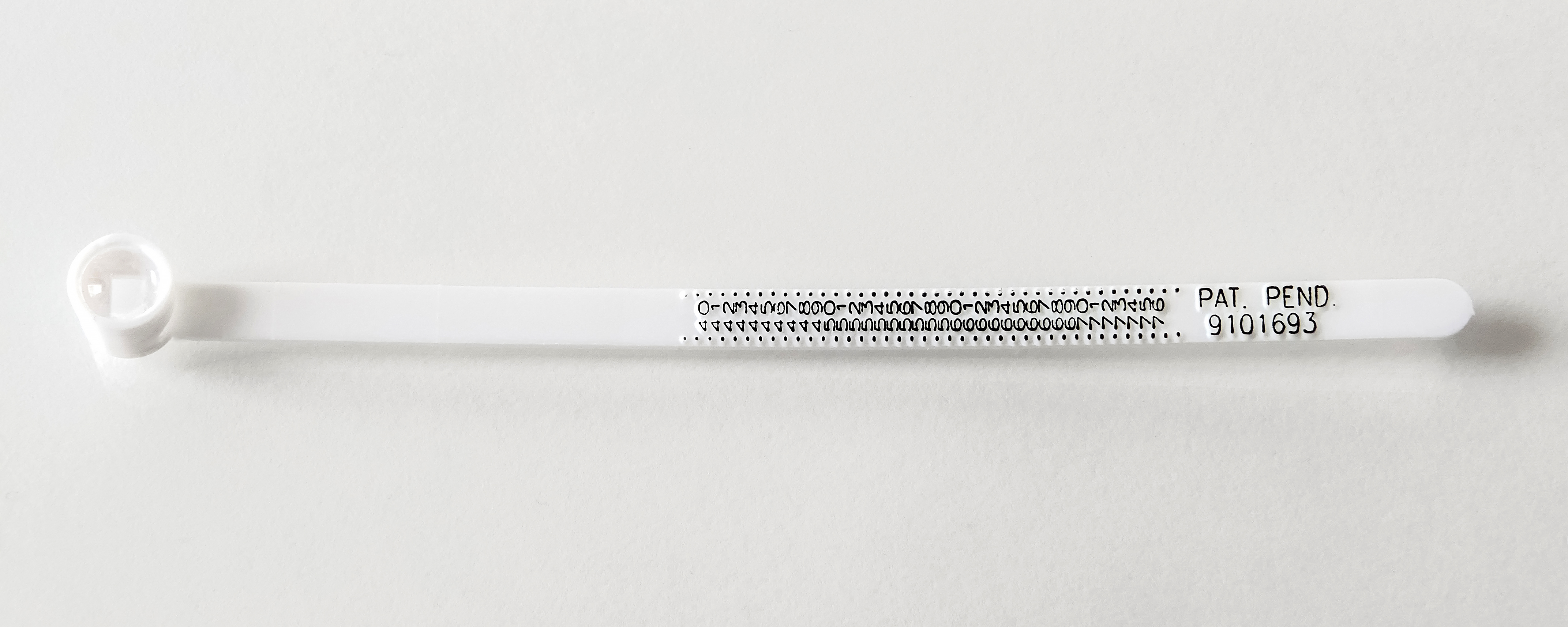
This guide asks one practical question: what should you confirm before choosing a ring size? It concerns fit and purchase preparation, not authentication or value. The photographed plastic tool is a real, licensed image used to make the subject concrete. We have not tested the tool, and its presence does not establish that a home measurement will match a jeweller’s gauges.
Name the measurement before comparing the numbers
Inside diameter is the distance across the opening; inside circumference is the distance around it. They are not interchangeable. GIA publishes an international chart because countries use different sizing scales. Ask the seller to state the system behind a number or letter and the physical dimensions used to interpret it. Avoid combining a bare “size 6” from one listing with an unexplained conversion from another.
A chart also assumes a suitable measurement. GIA’s technical guidance says a ring’s inside must be perfectly round when using an inside measurement against a chart. A distorted or deliberately non-round ring needs professional interpretation. For an existing jewel, tell the jeweller which hand and finger actually wears it; a ring taken from another finger is a reference object, not a final answer.
Width and inner profile deserve their own fitting
If the intended design is broad, ask for a fitting gauge or sample appropriate to that breadth. If the interior is rounded, discuss that profile too. A thin gauge is not automatically a faithful stand-in for a wide band. GIA’s separation of these engineering cases is the reason to ask a specific question rather than applying a universal instruction to go up a fixed fraction of a size.
For a stack, try the intended rings together. More surface in contact with the finger can change the wearing experience, and a setting may prevent two rings from sitting as expected. Ask whether the quoted size describes the finished piece and how the maker checks it. Our editorial preference is to settle the wearing arrangement before commissioning engraving or another difficult-to-reverse detail.
Let the appointment reflect ordinary wear
GIA recommends professional measurement and notes that temperature and time of day can affect finger size. Tell the jeweller if the fitting follows unusually hot or cold conditions, and ask whether a repeat check would help. Do not turn an uncomfortable moment into a number you must defend. The objective is a ring that passes the knuckle and remains comfortably secure, not the smallest size that can be forced on.
Move the hand naturally and discuss how easily the ring goes on and comes off. A tall or top-heavy design may behave differently from a plain band; bring that observation into the conversation. Do not make your own sizing alteration or force a ring during a trial. This is a fitting discussion for the actual hand and design, not a promise that one numerical adjustment solves every case.
An original fitting brief: a wide band bought online
Here is a hypothetical example, not a test of a real product. A reader owns a comfortable narrow ring and wants a wide, rounded-interior band for the same finger. The useful brief says: exact hand and finger; existing ring measured by the jeweller; proposed band width; proposed inner profile; whether it will be worn alone; seller’s sizing system; sample or gauge used. Leave the final size blank until the design-appropriate fitting is resolved.
Then add a decision line: “Do the sample and final ring share the relevant width and inner shape, and has the seller confirmed the finished size in writing?” If the answer is unclear, ask for clarification before payment. A string or paper strip is not a precision substitute: GIA warns that stretching, damage and failure to account for the knuckle can make these methods inaccurate. The exercise replaces a guess with an answerable set of questions.
Read the policy before assuming a second chance
GIA notes that pavé, channel-set and full-eternity designs can be difficult to resize. Do not assume every metal, setting or construction can be altered, or that “resizable” means any amount in either direction. Ask the seller what is possible for the specific piece, who performs it, what limits apply and whether finish, engraving or stone placement could be affected. No alteration is authorized merely because you requested a quote.
Confirm return or exchange terms, deadlines, made-to-order exclusions and any resizing charges in writing before ordering. These are questions for the seller’s current policy, not a universal legal entitlement asserted here. Keep the fitting record with the order confirmation. The satisfying purchase is not the one with the most persuasive conversion chart; it is the one whose size, shape and next steps were understood before the box arrived.
Continue in the archive
Sources and image rights
Sources and image rights checked on 5 November 2026.