The familiar metal that once arrived as a marvel
Aluminium is abundant in the Earth’s crust, yet it does not occur there as an easy lump of metal waiting to be picked up. Separating it from its compounds was difficult and expensive. Cooper Hewitt dates its early industrial availability to the 1850s; the Science Museum describes nineteenth-century aluminium as an expensive curiosity once classed as a precious metal.
That gap between abundance and accessibility is the key. The novelty was not merely a fashionable colour. It was the visible result of new chemistry. At exhibitions and courts, a metal that now reads as everyday could signal modernity, technical command and privileged access. Jewellery gave that abstract achievement a body small enough to wear.
Read the object before the legend
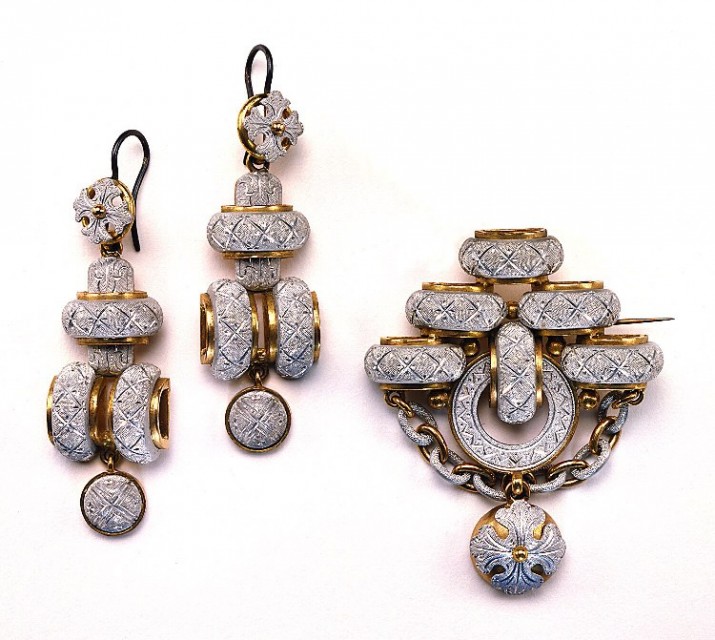
The Cooper Hewitt suite is a brooch and pair of earrings, probably made in France around 1860. The museum records bright-cut engraved aluminium set in elaborate gold mounts. Repeating half-cylinders, chevrons and foliate pendants turn the pale metal into a field of controlled reflections; the gold does not hide the aluminium but frames it.
This is where close looking becomes more useful than a slogan. Note the repeated modules, the contrast between cool and warm metals, the depth of the engraving and the movement supplied by the drops. Then separate observation from documentation: the object record supports material, approximate date and probable place, but it does not name a confirmed maker. A persuasive style is not a signature.
Why lightness mattered to the design
Cooper Hewitt highlights three qualities that appealed to jewellers: aluminium was light, malleable and resistant to the tarnishing associated with silver. Those qualities helped elaborate forms remain wearable and let engravers create broad, lively surfaces without relying on gemstone sparkle.
Lightness is not an apology for a ‘lesser’ material. It is a design condition. It changes scale, balance and comfort. The useful question for any unusual-metal jewel is therefore not only ‘what is it made from?’ but ‘what did this material allow the maker to do?’ That question also guards against judging a historic object solely by today’s commodity hierarchy.
How the luxury signal collapsed
In 1886, Charles Martin Hall and Paul Héroult independently developed the electrolytic process that became the basis of economical aluminium production. As supply expanded and cost fell, scarcity stopped carrying the same social message. Cooper Hewitt notes that aluminium jewellery moved away from elite novelty and towards more ordinary or industrial associations by the end of the century.
The workmanship did not evaporate when the raw material became cheaper. This distinction matters for collectors: material price, historical significance, construction quality, condition and provenance are different questions. A dramatic origin story cannot authenticate an unmarked piece, establish its date or produce a valuation.
A five-line checklist for an unusual-metal jewel
First, copy every mark exactly and photograph it beside a scale. Second, describe construction and surface rather than guessing a technique. Third, ask what evidence supports the metal identification: a seller’s label, an old invoice and a qualified non-destructive analysis do not carry equal weight. Fourth, compare the entire design—not one motif—with catalogued museum objects. Fifth, record repairs, replacement findings and mixed metals, because a jewel may have several material histories at once.
A 10× loupe can help you inspect joins, engraving and marks, but it cannot authenticate the jewel or identify an alloy by sight. Do not scrape, acid-test or polish a historic surface at home. For a consequential purchase or treatment decision, ask an appropriately qualified jewellery historian, conservator, gemologist or assay professional to examine the actual object.
What this small suite changes
The brooch and earrings make luxury feel less like a fixed ladder and more like a moving agreement between rarity, technology, fashion and handwork. Gold here remains gold, but aluminium carries the shock of the new. A century and a half later, the surprise runs in reverse: the ordinary metal asks us to recover the astonishment its first wearers could see.
That is the practical reward of material history. It slows down easy conclusions. Instead of asking whether aluminium is precious, ask when, to whom, by what process and in what object it became worth attention.
Continue in the archive
Authoritative sources and image licence
Object record, image rights and historical sources checked 15 October 2026.
- Smithsonian Institution — Brooch and pair of earrings, ca. 1860; object record and CC0 rights ↗
- Cooper Hewitt, Smithsonian Design Museum — Festive Foil? ↗
- British Museum — Aluminium flower-head bracelet, object 1991,0106.1 ↗
- Royal Society of Chemistry — Aluminium: element information, properties and history ↗
- Science Museum Group — Bar of aluminium given to Michael Faraday by Napoleon III, c. 1855 ↗